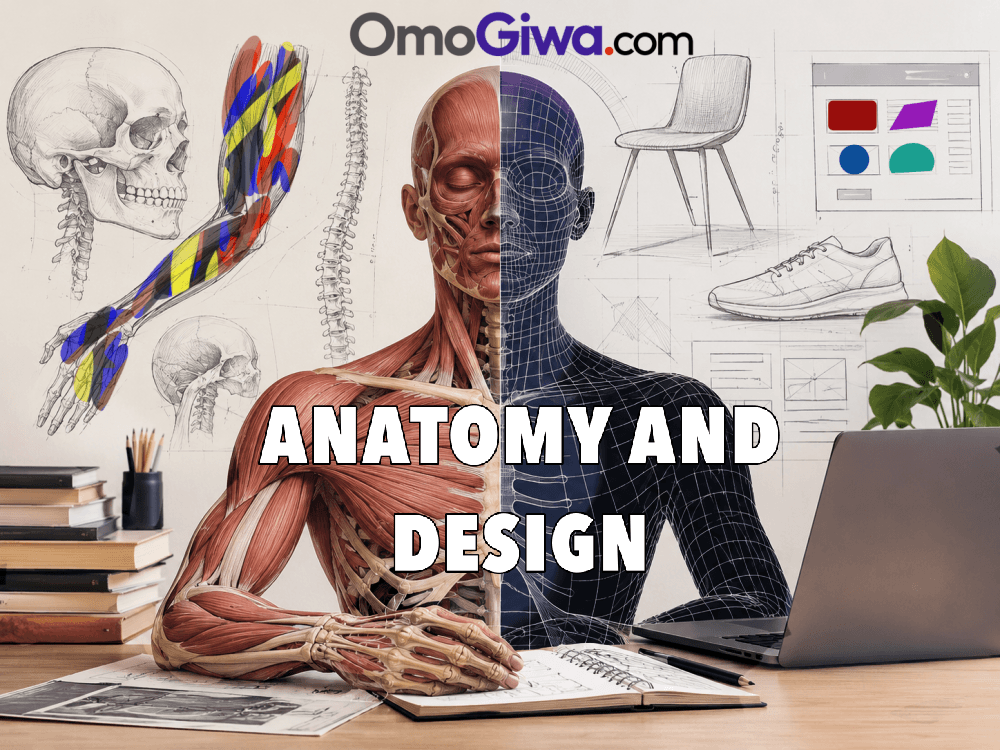
I studied human anatomy, and I work as a designer. At first glance, those two things might seem like they belong in entirely different worlds. One deals with the science of the human body; the other deals with creativity, communication, and solving problems.
But the more I think about it, the more I realise that they have something important in common: both require us to understand how things work, how their parts relate to one another, and why their structure matters.
That connection has influenced how I see design. And no, I am not suggesting that every designer needs to memorise the bones of the human body. Although knowing a few would not hurt.
Looking Beyond the Surface
I have always been interested in how things work. Not just how they look, but what happens beneath the surface to make them function. That curiosity is one of the things that connects my background in human anatomy with my work as a designer.
Studying anatomy taught me to look beyond appearances. The human body is an incredibly organised system of structures, each with its own role, yet all working together to keep us alive. Bones provide support, muscles produce movement, nerves transmit information, and organs perform specialised functions.
The more I understood these relationships, the more I began to recognise a similar principle in design: what we see on the surface is only part of the story.
A well-designed product, website, or visual identity is not simply something attractive. It has an underlying structure. Its individual parts work together to serve a purpose.
That is where anatomy and design begin to meet.
Form and Function: A Lesson From the Human Body
One of the most interesting things about the human body is how closely its structure relates to its function.
The shape of a bone affects how it supports weight. The arrangement of muscles influences movement. The structure of a joint determines the kinds of movement it can perform.
These structures are not random. Their forms are closely related to what they need to do.
Design works in a similar way.
A chair should do more than look good in a photograph. It should support the person sitting in it. A website should not only have an attractive interface; it should help people find information and complete tasks without unnecessary frustration.
A brand identity should not simply look impressive. It should communicate something meaningful about the business behind it.
This is why I see design as a balance between form and function. Aesthetics matter, but they become much more valuable when they are supported by purpose.
Studying anatomy gave me another way to understand this relationship. It encouraged me to ask not just what something looks like, but why it is structured the way it is.
The Human Body as a Design Reference
The human body can teach us a lot about designing things for people. Its proportions, movements, limitations, and abilities provide useful reference points for solving practical design problems.
In product design, for example, understanding body measurements and movement can help determine whether an object is comfortable, accessible, and safe to use. This is one of the reasons ergonomics and anthropometry are important in designing furniture, clothing, tools, and everyday products.
A desk that looks beautiful but forces someone into an uncomfortable position is not particularly successful design. Neither is a mobile interface whose controls are difficult to reach or interact with.
The same principle applies to digital experiences. When I approach a website, I think about the person on the other side of the screen: how they navigate, what they need to understand, and how easily they can move from one action to another.
We may not be designing bones or muscles, but we are designing experiences for the people who have them.
Understanding the human body is therefore not limited to medical practice. It can also contribute to the way we create products, interfaces, environments, and visual experiences.
Why Understanding Anatomy Isn't Enough
Here is where things become a little more complicated.
Knowing how the human body works does not automatically make someone a good designer. Anatomy can provide useful insights, but design requires more than biological knowledge.
It also requires creativity, observation, research, experimentation, and an understanding of the problem being solved.
The human body can serve as a reference, but it should not become a rigid blueprint that every design must follow.
A solution that works for one person may not work for another. People differ in body proportions, physical abilities, experiences, and cultural expectations. Good design needs to recognise these differences rather than assume that one solution will suit everyone.
This distinction matters to me because design is not about copying nature or applying scientific facts without question. It is about understanding the problem, identifying useful principles, and deciding how to apply them appropriately.
Science can help us ask better questions. Design helps us explore possible answers.
Learning From Biology, Not Just Copying It
There is another connection between anatomy and design that I find particularly interesting: biomimicry.
Biomimicry involves learning from structures, processes, and strategies found in nature to develop solutions to human problems.
In architecture, designers can study natural structures to explore ways of organising space, distributing loads, or improving environmental performance. In product development, biological principles can inspire new materials, forms, and mechanisms.
The important part is not simply making something look like an organism. It is understanding what makes a natural system effective and exploring whether the underlying principle can solve a design problem.
This is a useful way to think about creativity. Inspiration does not always have to come from another designer, a trend, or an existing product. Sometimes, the natural world offers a different way to approach a familiar problem.
Anatomy gives us one perspective on that world, but biology offers many more lessons that designers can explore.
Designing for Real People, Not an Imaginary Average
One of the biggest lessons I take from studying the human body is that human variation matters.
People do not share identical proportions, physical abilities, or needs. A design based on a narrow idea of the average person can unintentionally exclude the people who do not fit that assumption.
This is particularly important when designing furniture, clothing, medical devices, public spaces, and digital products.
Ergonomics and anthropometric research can help designers understand the people who will use a product. However, the quality of that research matters. Data collected from one population may not accurately represent another.
For example, using measurements that do not adequately reflect the intended users can result in products that fit poorly or create unnecessary discomfort. This is one reason locally relevant anthropometric data is important, including research that reflects African populations.
Inclusive design also means considering accessibility, different levels of ability, and the circumstances in which a product will actually be used.
To me, this is where understanding anatomy becomes especially valuable: it reminds us that design is ultimately experienced by real, diverse human beings.
Where Anatomy Meets Technology
Technology is creating even more opportunities to bring anatomical knowledge into design.
Three-dimensional modelling can help researchers and designers visualise complex structures. Three-dimensional printing can turn digital models into physical objects, including anatomical models and components used in medical applications.
Digital scanning and modelling can also support the development of products that need to account for individual anatomy, while advances in prosthetics and assistive devices continue to explore ways of improving function and usability.
Artificial intelligence introduces further possibilities for analysing data, supporting design workflows, and assisting with medical imaging and modelling.
But technological progress does not remove the need for human judgement. Data can be incomplete, models can reproduce biases, and a technically impressive result may still fail the people it is supposed to serve.
Privacy, safety, accessibility, and proper testing remain important, particularly when a design affects health or physical wellbeing.
Technology gives us new tools. Understanding the people who use those tools helps us use them more responsibly.
What This Means for Me as a Designer
My background in human anatomy has influenced the way I approach design, but not because I believe every creative problem needs a biological explanation.
It has taught me to pay attention to structure, relationships, and function. It has encouraged me to look beyond what is immediately visible and ask why something works the way it does.
Those habits are useful whether I am working on a brand identity, a website, a digital experience, or a visual communication project.
When developing a brand, I think about how its individual elements work together to communicate a consistent identity. When designing a website, I consider the relationship between its structure, content, visual hierarchy, and usability.
Different projects require different methods, of course. But the underlying approach remains similar: understand the problem, study the relevant relationships, and build a solution with intention.
My work sits at the intersection of different disciplines, and I consider that a strength. Design does not happen in isolation, and some of the most useful ideas emerge when we connect knowledge from fields that might initially seem unrelated.
Anatomy is one of those fields for me. It has given me another lens through which to observe the world, approach problems, and make creative decisions.
Final Thoughts: Creativity Doesn't Belong in One Box
The relationship between anatomy and design is a reminder that creative thinking does not have to stay within the boundaries of one discipline.
Understanding the human body can help us think more carefully about form, function, movement, comfort, and the people who interact with what we create. When combined with research, creativity, and thoughtful problem-solving, that knowledge can contribute to better design decisions.
But the bigger lesson for me goes beyond anatomy. Knowledge from different fields can complement one another in unexpected ways. Sometimes, a perspective gained from one discipline helps us see a problem in another more clearly.
That is one of the reasons I enjoy working across design and technology. Each field brings a different way of thinking, and connecting them creates room for new possibilities.
I don't believe creativity belongs in just one box. And I don't think the ideas that shape our best work should have to stay in one either.